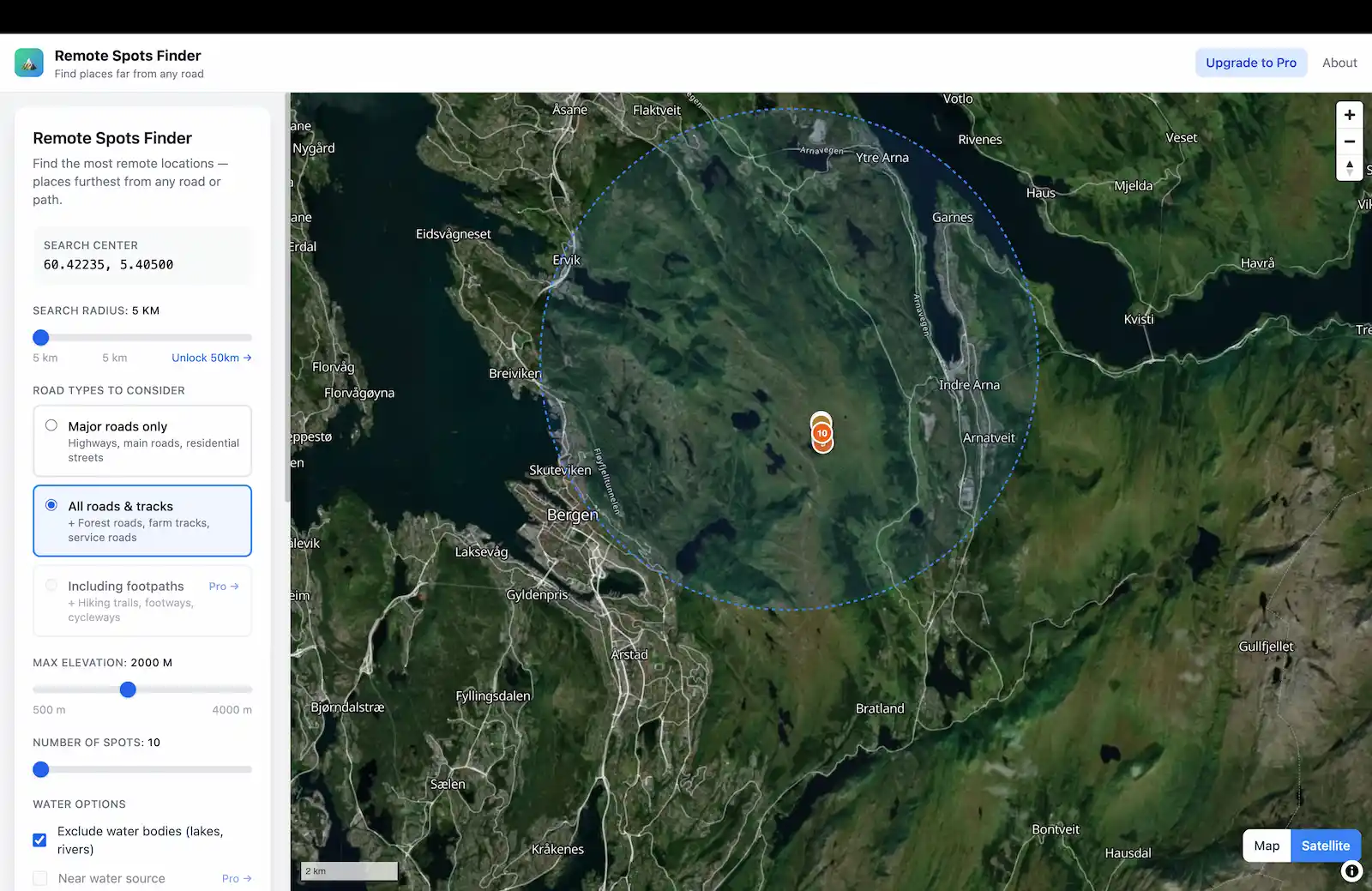
From deep fjords to arctic plateaus, Norway offers some of the most remote and dramatic wilderness in Europe. Under Allemannsretten — the Right to Roam — you can camp freely on uncultivated land anywhere in the country. Our tool finds the exact GPS coordinates of the spots furthest from any road.
Explore Norway on the mapFree to use · No signup required
Norway stretches over 1,700 kilometers from south to north, with a landscape dominated by mountains, fjords, glaciers, and vast arctic plateaus. Much of the country's interior is virtually roadless — the road network hugs the coast and valley floors, leaving enormous areas of highland terrain completely untouched. These are the areas our algorithm identifies.
The numbers speak for themselves: Norway has a population density of just 15 people per square kilometer, but this average is misleading — most Norwegians live along the coast, leaving inland areas with densities closer to 1–2 people per km². Entire mountain ranges in Troms, Nordland, and the interior of Southern Norway have no roads at all. Some spots in Finnmark are over 40 kilometers from the nearest road — among the most remote points in all of Europe.
Europe's largest mountain plateau is a vast, treeless expanse of tundra, lakes, and rivers at around 1,100–1,400 meters. Only two roads cross it (RV7 and RV37), leaving an area larger than many European countries completely roadless in between. Search with a 30–50 km radius around 60.1°N, 7.5°E — you'll find spots 15–25 km from the nearest road. Use the water filter to camp near one of the plateau's hundreds of lakes.
Home to Northern Europe's highest peaks, including Galdhøpiggen (2,469m) and Glittertind (2,452m), Jotunheimen is a rugged alpine landscape of glaciers, sharp ridges, and deep valleys. The adjacent Breheimen range is less visited and even more remote. The area between the two parks contains some of the wildest terrain in Scandinavia, with spots routinely 10–15 km from roads.
The dramatic Lofoten islands rise sharply from the Arctic Ocean with jagged peaks, hidden beaches, and narrow fjords. While the E10 runs along the main islands, the mountain interiors are surprisingly wild. Vesterålen to the north is quieter and offers larger roadless areas. Island searches work particularly well with our tool — the limited road network produces high remoteness scores even with small search radii.
Norway's northernmost regions contain Europe's last true wilderness. The Finnmarksvidda — a vast inland plateau — is one of the most sparsely populated areas in Europe. The Lyngen Alps in Troms offer dramatic fjord-to-summit terrain. Expect remoteness scores of 20–40+ km from roads in Finnmark — distances comparable to parts of Siberia. Be prepared for extreme conditions and limited rescue access.
Norway's oldest national park, Rondane, is a gentle highland of rounded peaks and wide valleys — less dramatic than Jotunheimen but deeply peaceful. Dovrefjell to the west is home to wild musk oxen and offers a unique arctic-alpine experience. Both areas have extensive roadless interiors and are well-mapped in OpenStreetMap.
The fjord regions of western Norway combine coastal access with extreme vertical terrain. The mountains between the fjords are often completely roadless — you can be at sea level and 15 km from the nearest road simultaneously. The areas around Jostedalsbreen glacier and the Sunnmøre Alps are particularly promising for finding dramatic remote spots with water access.
Norway's Allemannsretten (Right to Roam) is one of the most generous access laws in the world. Enshrined in the Outdoor Recreation Act (Friluftsloven), it grants everyone the right to camp on uncultivated land — forests, mountains, moorlands, and shorelines — regardless of who owns the land. This right is deeply embedded in Norwegian culture and widely respected.
The key rules: you must camp at least 150 meters from the nearest inhabited house or cabin. You can stay up to two nights in one spot without asking permission (longer stays require landowner consent, except in remote mountain areas where longer stays are generally accepted). Open fires are prohibited between 15 April and 15 September in or near forested areas — use a camping stove instead.
Cultivated land (innmark) — fields, pastures, and gardens — is off-limits for camping. In practice, this is rarely an issue when using Remote Spots, as the most remote locations are almost always on uncultivated mountain or forest land. National parks in Norway generally allow wild camping with no additional restrictions, making them excellent targets for our tool.
Remote Spots helps you find locations where wild camping is most rewarding — far from roads, cabins, and other campers. In Norway's vast wilderness, the challenge isn't legality but logistics: the further you go, the more self-sufficient you need to be.
Finding Norway's most remote wilderness takes about 30 seconds:
The Pro plan ($5, one-time) is strongly recommended for Norway — the 50 km radius is essential for scanning the vast highland plateaus, and the water filter helps you find spots near the lakes and rivers that are crucial for multi-day wilderness trips.