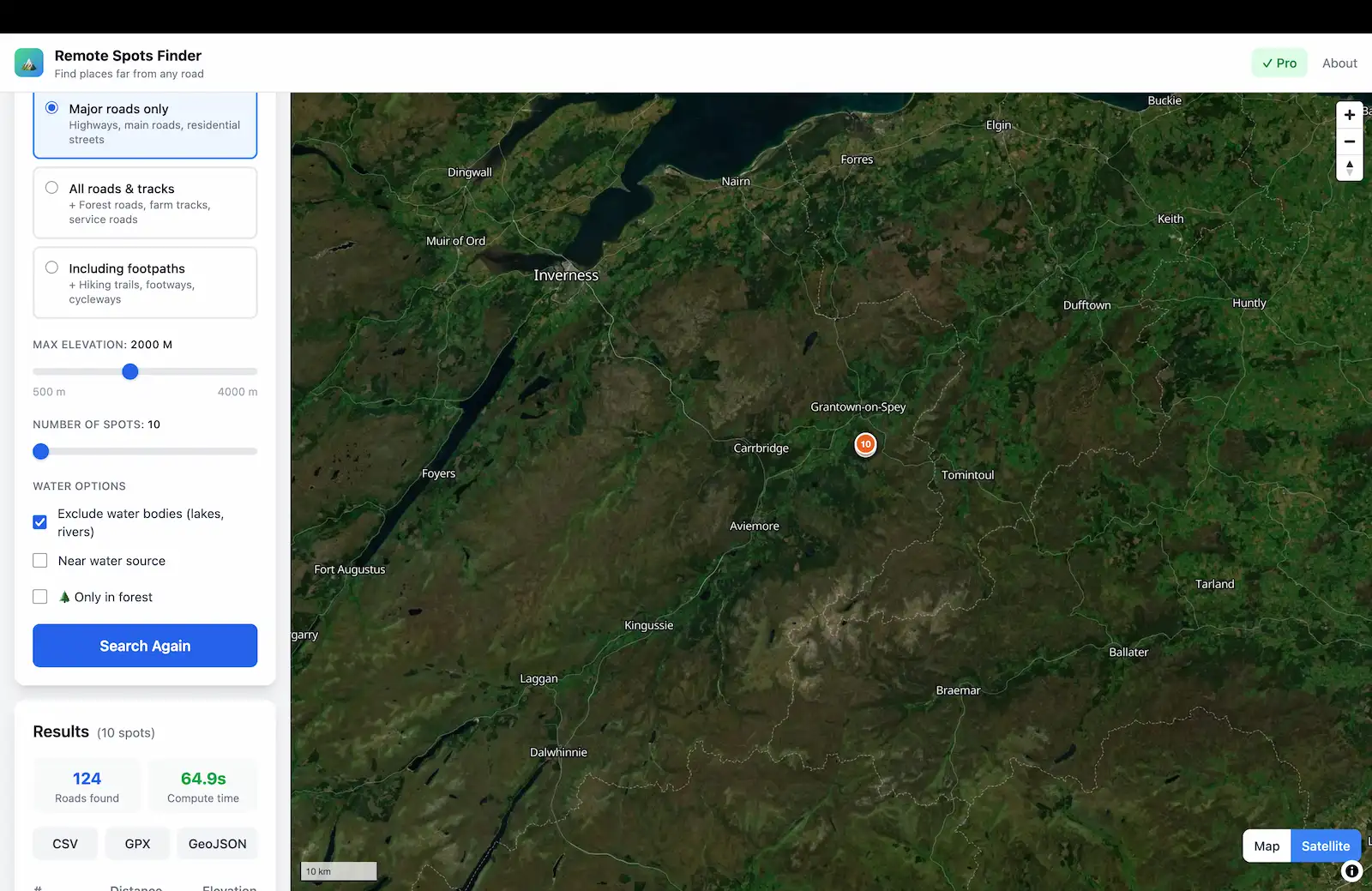
Vast moorlands, empty glens, and roadless mountain ranges — Scotland has some of the most remote terrain in Western Europe. Thanks to the Right to Roam, you can legally wild camp almost anywhere. Our tool finds the exact GPS coordinates of the spots furthest from any road.
Explore Scotland on the mapFree to use · No signup required
Scotland is one of the few places in Europe where wild camping is explicitly legal. The Land Reform (Scotland) Act 2003 gives everyone the right to camp on most unenclosed land — moorlands, forests, mountains, and shorelines — as long as it's done responsibly. Combined with some of the emptiest landscapes in the UK, this makes Scotland the ideal destination for finding truly remote spots.
The Scottish Highlands alone cover an area larger than Belgium, with a population density lower than most of Scandinavia. Entire mountain ranges have no roads running through them, and many glens are accessible only on foot. Our algorithm identifies the exact points within these areas that are furthest from any road — spots where you're genuinely miles from the nearest vehicle.
Often called "Britain's last wilderness", the Knoydart peninsula has no public road access at all. The Rough Bounds of Knoydart — between Loch Nevis and Loch Hourn — consistently produce some of the highest remoteness scores in the entire UK. Search with a 20 km radius around 57.0°N, 5.5°W for spectacular results. Expect to find spots 12–18 km from the nearest road.
The Cairngorms plateau is the largest area of high ground in the UK, with vast stretches above 1,000 meters that are completely roadless. The area between Ben Macdui and Braeriach is one of the most remote in Scotland. The forests of Rothiemurchus and Glen Feshie offer excellent spots with tree cover — use the forest filter to find sheltered camping locations among ancient Caledonian pines.
The far northwest of Scotland feels like the edge of the world. Vast, empty moorlands stretch between isolated peaks like Suilven, Stac Pollaidh, and Foinaven. The area between Ullapool and Durness is one of the least populated in Europe. Single-track roads are rare, and the terrain between them is completely wild. Use the water filter to find spots near the countless lochs that dot this landscape.
While the A82 runs through Glen Coe, the mountains on either side are remarkably wild. The ridges of Bidean nam Bian, the Aonach Eagach, and the remote Blackwater Reservoir area offer genuine solitude just a short walk from the road. Glen Etive — the dead-end road south of Glen Coe — gives access to vast roadless areas to the east.
The Hebridean islands offer a unique kind of remoteness — surrounded by ocean, with dramatic coastlines and very few roads. The Cuillin ridge on Skye, the empty western coast of Harris, and the entire island of Rum (owned by NatureScot with no cars) are excellent targets. Our tool works brilliantly on islands, where the limited road network means extreme remoteness scores even in small search areas.
Often overlooked in favour of the Highlands, Galloway Forest Park in southwest Scotland is a designated Dark Sky Park with extensive forest cover and very few roads. The Merrick range and the forests around Loch Trool are ideal for those who want remoteness combined with dense tree cover — perfect for the forest filter in our tool.
Scotland's Land Reform Act 2003 gives everyone the right of responsible access to most unenclosed land — including the right to wild camp. This makes Scotland one of the most camping-friendly countries in the world. The Scottish Outdoor Access Code defines wild camping as lightweight, done in small numbers, staying only two to three nights in any one place.
Key rules to follow: camp well away from buildings, roads, and enclosed farmland. Use small tents and keep group sizes minimal. Avoid camping on cultivated land, in people's gardens, or on golf courses. Leave absolutely no trace — carry out all rubbish and remove all signs of your stay. Use a camping stove rather than an open fire, especially during dry conditions when wildfire risk is high.
One important exception: Loch Lomond & The Trossachs National Park has seasonal bylaws (March–October) that restrict camping in certain popular areas. You'll need a permit to camp in designated zones within the park. Outside these specific zones and dates, regular access rights apply. The Cairngorms National Park does not have similar restrictions, though responsible behaviour is always expected.
Remote Spots helps you find locations where wild camping is most rewarding — far from roads, other campers, and populated areas. The further from a road you camp, the more likely you are to have complete solitude and avoid any conflicts.
Finding the wildest camping spots in Scotland takes about 30 seconds:
The Pro plan ($5, one-time) is recommended for Scotland — the larger 50 km radius lets you scan entire mountain ranges at once, and the forest/water filters are essential for finding quality wild camping spots.