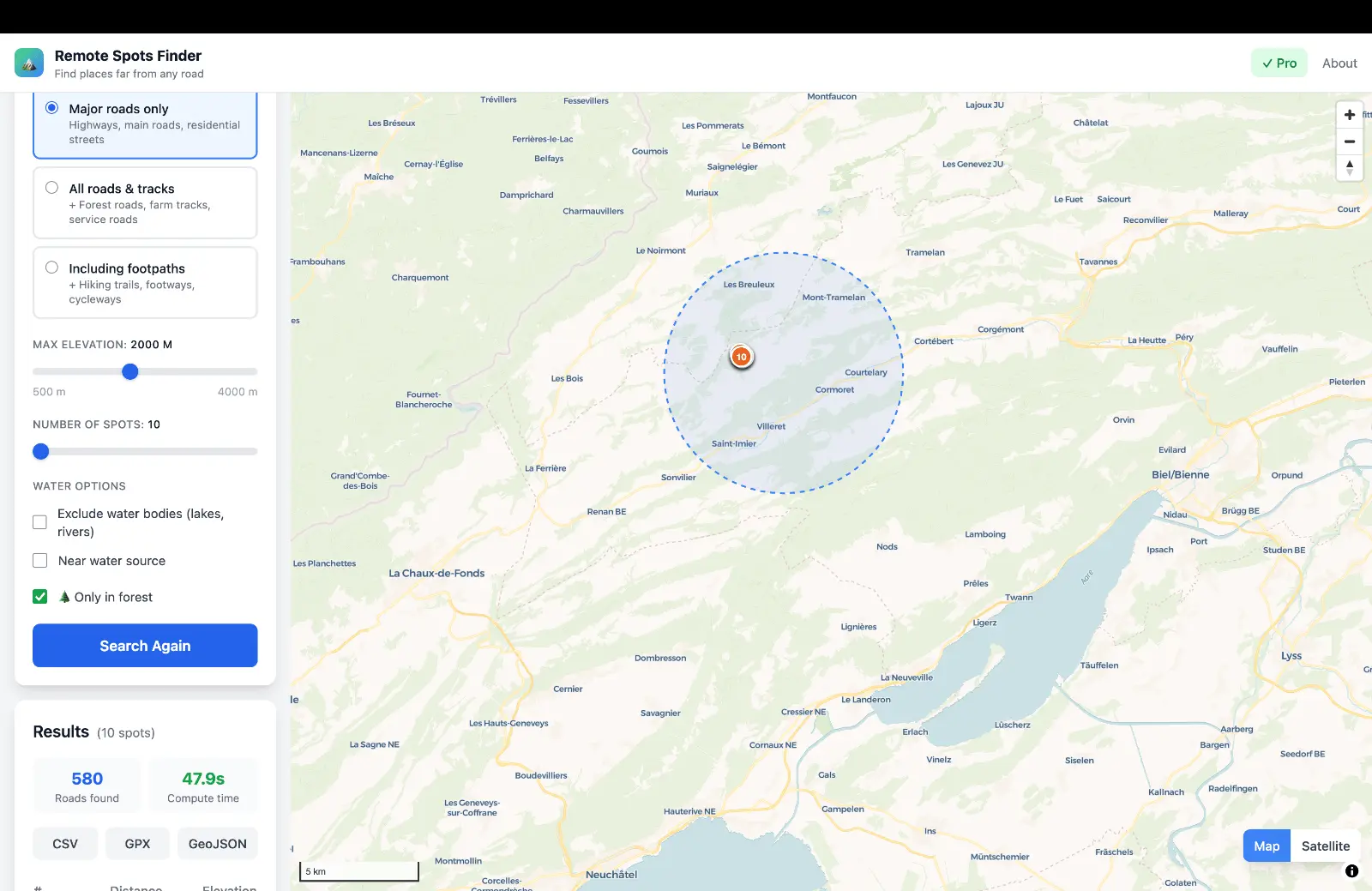
The Swiss Alps, Jura mountains, and Prealps hold some of Europe's most remote terrain — valleys with no roads, ridges hours from the nearest trail, and alpine plateaus where you won't see another person for days. Our tool finds the exact GPS coordinates of these hidden spots.
Explore Switzerland on the mapFree to use · No signup required
Despite being one of Europe's most densely populated countries, Switzerland contains vast stretches of roadless terrain. The combination of steep alpine topography and strict land-use planning means that large areas — particularly above 1,500 meters — remain untouched by vehicle infrastructure. These are the spots our algorithm finds.
The Swiss Alps alone cover about 60% of the country's surface area, and many valleys in cantons like Valais, Graubünden, and Uri contain areas that are more than 10 kilometers from the nearest road. In comparison, the most remote point in the entire UK is only about 8 kilometers from a road.
Home to the highest peaks in Switzerland, Valais contains some of the most remote terrain in all of Western Europe. The area around the Aletsch Glacier, the Val de Bagnes, and the high valleys south of Zermatt consistently produce spots 8–15 km from the nearest road. Try searching with a 20 km radius around coordinates 46.1°N, 7.8°E for impressive results.
The largest Swiss canton by area is also one of the most sparsely inhabited. The Swiss National Park near Zernez is completely roadless, and the wild valleys of the Engadin and Val Müstair offer genuine remoteness. The area around Piz Bernina and the Albula Alps are particularly promising for finding spots far from civilization.
The region between Grindelwald, Lauterbrunnen, and Kandersteg contains dramatic glacial valleys with very limited road access. The Gasterntal, accessible only by foot, and the high terrain around the Jungfrau massif are excellent areas to search for truly isolated spots.
Often overlooked, the northern part of Ticino around the Val Bavona and Val Verzasca contains wild alpine terrain with surprisingly few roads. The southern feel — warmer temperatures, Mediterranean vegetation at lower altitudes — makes it attractive for off-grid camping during spring and autumn.
While not as dramatic as the Alps, the Jura offers a different kind of remoteness: dense forests, limestone ridges, and far fewer hikers. The area around the Creux du Van and the Chasseral is ideal for those seeking solitude in forested terrain. Use the "forest cover" filter for best results here.
Switzerland doesn't have a blanket "right to roam" like Scandinavian countries, but wild camping (bivouacking) is broadly tolerated with some important distinctions. The Swiss Alpine Club (SAC) and cantonal regulations generally allow single-night bivouacs above the treeline (roughly above 2,000 meters) as long as you're not in a protected area, national park, or wildlife reserve.
Key rules to keep in mind: bivouacking (sleeping without a tent, or with a minimal shelter) is more accepted than tent camping. Protected areas like the Swiss National Park, hunting reserves, and federal wildlife areas prohibit all overnight stays. Some cantons (especially in the Jura) have stricter regulations. Always practice Leave No Trace and check local rules before heading out.
Remote Spots helps you find locations where bivouacking is most likely to be legal and undisturbed — high-altitude spots with forest cover and water access, far from both roads and popular hiking trails.
Finding the most remote spots in the Swiss Alps takes about 30 seconds:
The Pro plan ($5, one-time) is recommended for Switzerland as it unlocks the larger search radius (up to 50 km) and the forest/water filters that are essential for finding quality bivouac spots.