Endless boreal forests, arctic mountains, and Europe's last true wilderness areas — Sweden offers remoteness on a scale few countries can match. Under Allemansrätten, wild camping is a constitutional right. Our tool finds the exact GPS coordinates of the spots furthest from any road.
Explore Sweden on the mapFree to use · No signup required
Sweden is the fifth-largest country in Europe by area but has a population of only 10 million, most of whom live in the southern third. The northern two-thirds of the country — roughly the size of the United Kingdom — is dominated by boreal forest (taiga) and arctic mountain terrain with extremely low population density. Entire municipalities in Lapland have fewer than 0.5 inhabitants per square kilometer.
The Swedish mountain range (Skanderna/Fjällen) along the Norwegian border is one of the most extensive roadless areas in Europe. Sarek National Park alone — often called Europe's last wilderness — has no roads, no marked trails, and no huts. Our algorithm thrives in these conditions, finding spots that can be 30–50 km from the nearest road in northern Sweden.
But remoteness in Sweden isn't limited to the mountains. The vast boreal forests of inland Norrland — stretching from Dalarna to Norrbotten — contain thousands of square kilometers of roadless forest, rivers, and lakes. Even in southern Sweden, the forests of Småland and the lake district offer surprising pockets of isolation.
Sarek is the crown jewel of European wilderness — 2,000 km² of glaciers, deep valleys, and sharp peaks with no roads, no marked trails, and no facilities. Adjacent Padjelanta is equally vast and even less visited. Search with a 50 km radius around 67.3°N, 17.5°E for some of the highest remoteness scores anywhere in Europe. Only attempt this area if you're experienced in wilderness navigation.
The area around Sweden's highest peak Kebnekaise (2,097m) and the famous Kungsleden trail offers a mix of marked and unmarked terrain. While the trail itself is well-traveled, stepping off it in any direction quickly leads to genuine wilderness. The valleys east of Kungsleden — toward Sitasjaure and Vistasvagge — are particularly remote and less visited.
Sweden's largest nature reserve (5,600 km²) stretches across a vast area of mountain and forest terrain south of Sarek. Less famous than the national parks further north, Vindelfjällen offers equally impressive remoteness with fewer visitors. The Vindel River valley and the surrounding mountains are excellent targets — particularly with the forest filter enabled for sheltered camping at lower elevations.
Stora Sjöfallet National Park contains dramatic mountain landscapes and one of Sweden's largest remaining old-growth forests. Nearby Muddus National Park protects vast, untouched boreal forest with ancient trees, bogs, and gorges. These parks are part of the UNESCO Laponia World Heritage Site and offer remarkable remoteness at lower elevations — ideal for those who prefer forest camping over exposed mountain terrain.
The vast boreal forests between the mountain range and the coast are some of the most overlooked wilderness areas in Europe. Thousands of lakes, countless rivers, and logging roads that peter out into trackless forest. Use the water filter to find spots near lakes — there are so many that you're never far from one. These forests are also excellent for the "forest cover" filter.
For those who don't want to travel to the Arctic, the forests of Småland and Tiveden National Park in central-southern Sweden offer a gentler version of remoteness. Dense conifer and mixed forests, countless lakes, and relatively low population density make these areas surprisingly isolated. The remoteness scores are lower than Lapland, but still impressive for Western Europe — and the milder climate extends the camping season considerably.
Sweden's Allemansrätten (Right of Public Access) is one of the world's most far-reaching outdoor access laws — and uniquely, it's protected by the Swedish constitution. It grants everyone the right to walk, ski, cycle, and camp on any land that isn't a private garden, cultivated field, or close to a dwelling. No permission needed. No fees. No registration.
The key rules for camping: you may camp for one or two nights without the landowner's permission, as long as you're out of sight of the nearest dwelling and not on cultivated land. You must leave no trace — carry out everything you bring in. Open fires are allowed with extreme caution, but many counties (län) issue temporary fire bans during dry summer periods. Always check brandriskkarta.se before lighting a fire.
In national parks and nature reserves, additional rules may apply — some restrict camping to designated areas or specific time periods, and dogs may need to be leashed. Sarek National Park, despite its extreme remoteness, has no camping restrictions at all — you can pitch your tent anywhere. The same applies to most of the mountain region.
Remote Spots helps you find the places where Allemansrätten is most rewarding — deep in the forest or high in the mountains, far from roads and other people. In Sweden, the right to camp is absolute; the tool helps you find where to exercise it.
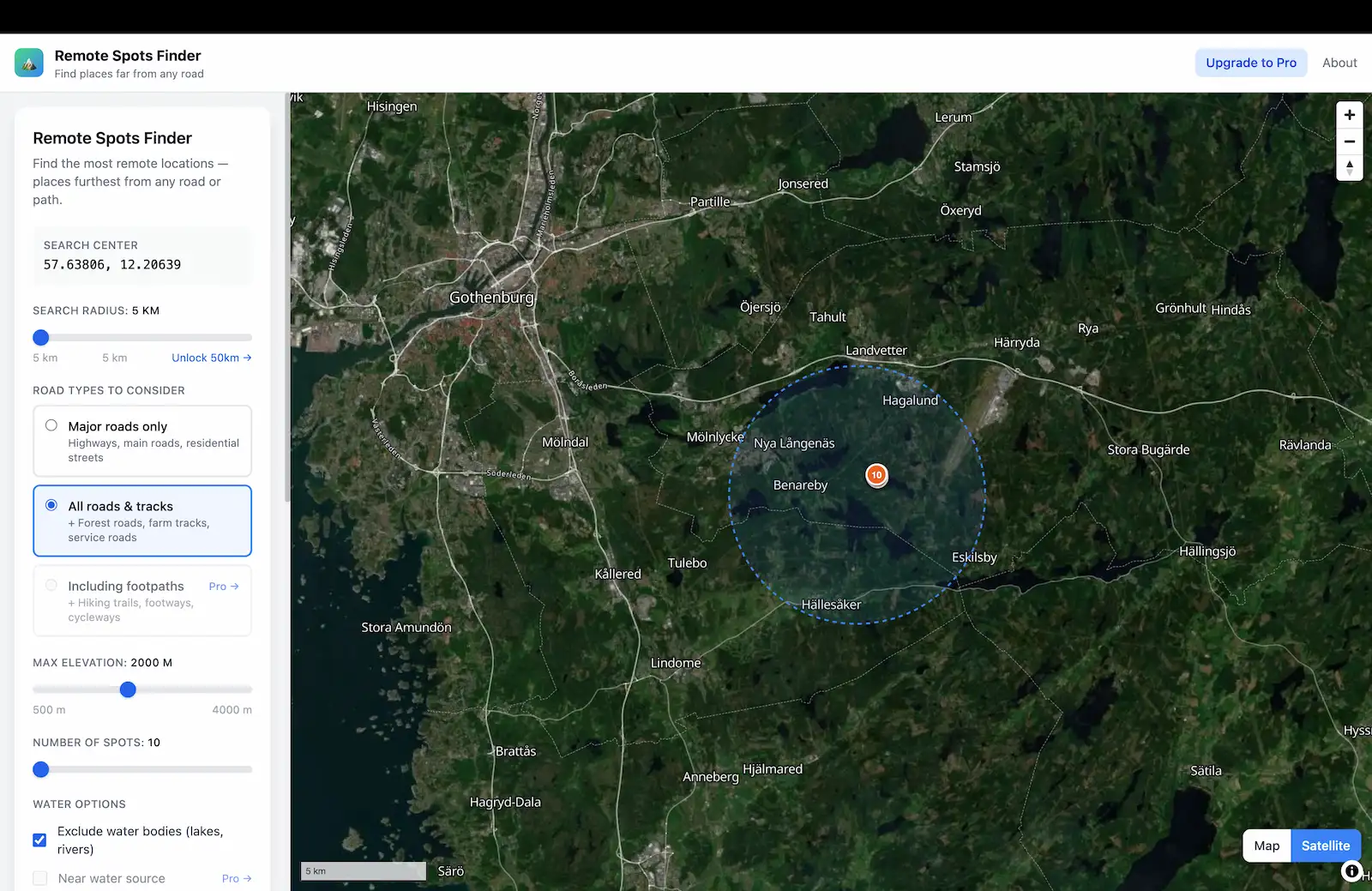
Finding Sweden's most remote wilderness takes about 30 seconds:
The Pro plan ($5, one-time) is strongly recommended for Sweden — the 50 km radius is essential for scanning the enormous wilderness areas of Lapland, and the forest and water filters are crucial for finding quality spots in the taiga.